
Edmonton's Homeless Strategy at a Crossroads - There's Always More to the Story
On September 15, the Criminal Trial Lawyers’ Association’s Policing Committee (CTLAPC), Edmonton Coalition on Housing and Homelessness (ECOHH), the Coalition for Justice and Human Rights (CJHR), and Justice & Equity Alberta (JEA) released data from the City of Edmonton obtained under the Access to Information Act. This data calls out for public attention and serious scrutiny by our elected officials. This data shows how City of Edmonton Transit Peace Officers issued more than three million dollars worth of trespass tickets to people with no fixed address.

Shocking as these stats are, there's always more to the story. Dr. Joshua Evans, Associate Professor of Human Geography at the University of Alberta, provides a detailed analysis of where Edmonton's Homeless Strategy has gone wrong. In this post you'll find:
How We Got to This Mess
The city was among the first in Canada to adopt a 10-year plan to end homelessness and more than 23,908 people have been rehoused through Housing First programs since 2009 (Homeward Trust Edmonton 2026). However, since 2020, the provincial government has embarked on a path of overhauling and ultimately slashing funds for the same support services that cut homelessness by nearly 50% over 10 years (The Alberta Worker 2022, CBC News 2024, ECOHH 2024, 2026, GlobalNews 2026).
These changes have contributed to devastating results. Today, the number of people experiencing homelessness is 2.5 times higher than it was when Homeward Trust Edmonton started its By-Name List in 2017 (Homeward Trust Edmonton 2026). The current provincial government no longer speaks of the Housing First model, and is instead focused on expanding emergency shelters (which is not housing), dismantling encampments on public lands, and pushing a new “recovery-based” model of care.
The Unfolding Disaster
On top of the abandonment of Housing First, a proven and sound policy when dealing with homelessness, a whirlwind of public backlash and political pressure is pushing city council and city administration to accept enforcement-centred responses as a necessary and appropriate fallback. This includes encampment sweeps and “hot-spot” policing, enforcement approaches that increase harm among people experiencing homelessness.
ECOHH believes this is a leap in the wrong direction, and recent revelations regarding the disproportionate impacts of these enforcement-centred responses on people experiencing homelessness is cause for grave concern. Enforcement approaches are contributing to the dehumanization of vulnerable people in our community. The solution to homelessness is not confiscating and trashing personal property, banning people from essential services or issuing exorbitant fines for trespassing. The solution to homelessness is immediate access to adequate housing.
Housing is the Solution to Homelessness - and It's Impossible to Access
Immediate access to housing is not something available to people experiencing homelessness in Edmonton. According to the City of Edmonton’s own reports, individuals and families requiring time-limited support in private market housing wait an average of 107 days to be assigned to a housing worker and, once assigned, an average of 60 days to become housed. For those in need of supportive housing, the average time spent on the By Name List prior to housing is 513 days (City of Edmonton 2026). Civida, Edmonton’s largest provider of social housing, has reported wait lists as long as 10,000 applications (City of Edmonton 2023). This is the experience of many Edmontonians without permanent housing: waiting months and years for housing (CBC News 2025).
No Housing...and No Shelter
Many of those who are waiting for housing are forced to seek shelter in public spaces. These spaces are becoming traps as they are increasingly being targeted by law enforcement who use bylaws to ban and ticket individuals. As Police Chief Driechel put it, this is “a data-driven approach to deploy more resources to areas with higher crime, otherwise called crime treatment zones.” This form of “hot-spot” policing—sometimes referred to as “blitz” policing—is a deterrence-based approach to crime prevention and it is being applied to address public safety concerns in Edmonton.
At issue here is not simply the existence of public spaces bylaws or transit bylaws (although there are issues with these); it is the way in which they are being enforced and the consequences for people experiencing homelessness. There are three fundamental reasons why “hot-spot policing” is wrongheaded as a means for solving homelessness: it can contribute to physical harm, it is counterproductive, and it is a form of indirect discrimination.
"Integrity, Courage, Community...Discrimination?"
First, this type of “hot-spot” policing can increase harms such as the risk of frostbite injury. Many people experiencing homelessness use transit stations to warm during cold winter months. Banning individuals from these spaces for months or years increases their exposure to cold temperatures. Data obtained from the City of Edmonton shows that 1,146 bans were issued to people with no fixed address.
This is concerning because we know that people experiencing homelessness are at greater risk of frostbite and death. Recent research found that houselessness was a precipitating factor in 40% of frostbite cases in Edmonton and Calgary (Inner City Health and Wellness Program 2026). Reporting last December revealed that more than half (58%) of the amputations performed in Edmonton were on patients experiencing homelessness (CBC News 2026). Justifiably, Edmonton has earned the reputation as the “frostbite capital of the world” (Edmonton Journal 2025). Hot-spot policing might deter criminal behaviours; however, targeting areas where homeless people are seeking shelter deters survival!
The Real Cost of Current Policing on Individuals Experiencing Homelessness
This past June, ECOHH gathered to honour the 349 people that died while unhoused, 10 times more than were recorded in 2005 (ECOHH 2026). While there is some evidence supporting the effectiveness of “hot-spot” policing in deterring some types of crime, there is zero evidence that hot-spot policing is effective in solving homelessness. In fact, most experts are quick to point to its harms when it comes to people experiencing homelessness (The Tyee 2026).
Second, “hot-spot” policing is counterproductive. In 2025, 5,748 tickets were issued in Edmonton’s transit system under Alberta’s Trespass to Premises Act to people with no fixed address—86 per cent of the total of 6,673 trespass tickets issued. Each of those tickets carried a fine of $600, so the total value of those tickets was $3,448,800. Trespass tickets are issued when officers have reason to believe a person is on transit property despite being banned. Bans themselves can be verbal or written and can be issued for obstruction, fare evasion or drugs, all of which are minor bylaw offenses. In practice, some individuals face thousands of dollars in fines over minor bylaw offenses. If rehousing these community members is the goal, saddling them with fines is not the answer.
Third, using “hot-spot” policing in transit zones as a means to quell social disorder is a recipe for de facto discrimination because while it is focused on behaviours it is disproportionately applied to Indigenous peoples and people with disabilities, groups that are overrepresented in the homeless population. In Canada, vulnerable populations such as Indigenous peoples, people with physical disabilities, people with serious mental illness, seniors, newcomers, and youth are disproportionally homeless. According to Homeward Trust Edmonton’s reporting for the month of August, 48% of the 3,879 individuals (1,849) on the By Name List identify as Indigenous (Homeward Trust Edmonton 2026).
Officers are enforcing bylaws that are, in principle, neutral: they target behaviours, not specific groups or individuals. Nonetheless, because policing is targeted to areas used by people experiencing homelessness for temporary shelter, they are disproportionately exposed to surveillance and discretion by officers.
There may be compelling evidence supporting hot-spot policing in curbing violent crime or
property crime in a specific area; however, this does not automatically justify the application of this approach to areas where unhoused populations are concentrated. “Hot-spot” policing is susceptible to discriminatory outcomes, especially when targeted to areas where certain socio-economic groups are concentrated.
What We Should be Focusing on Instead
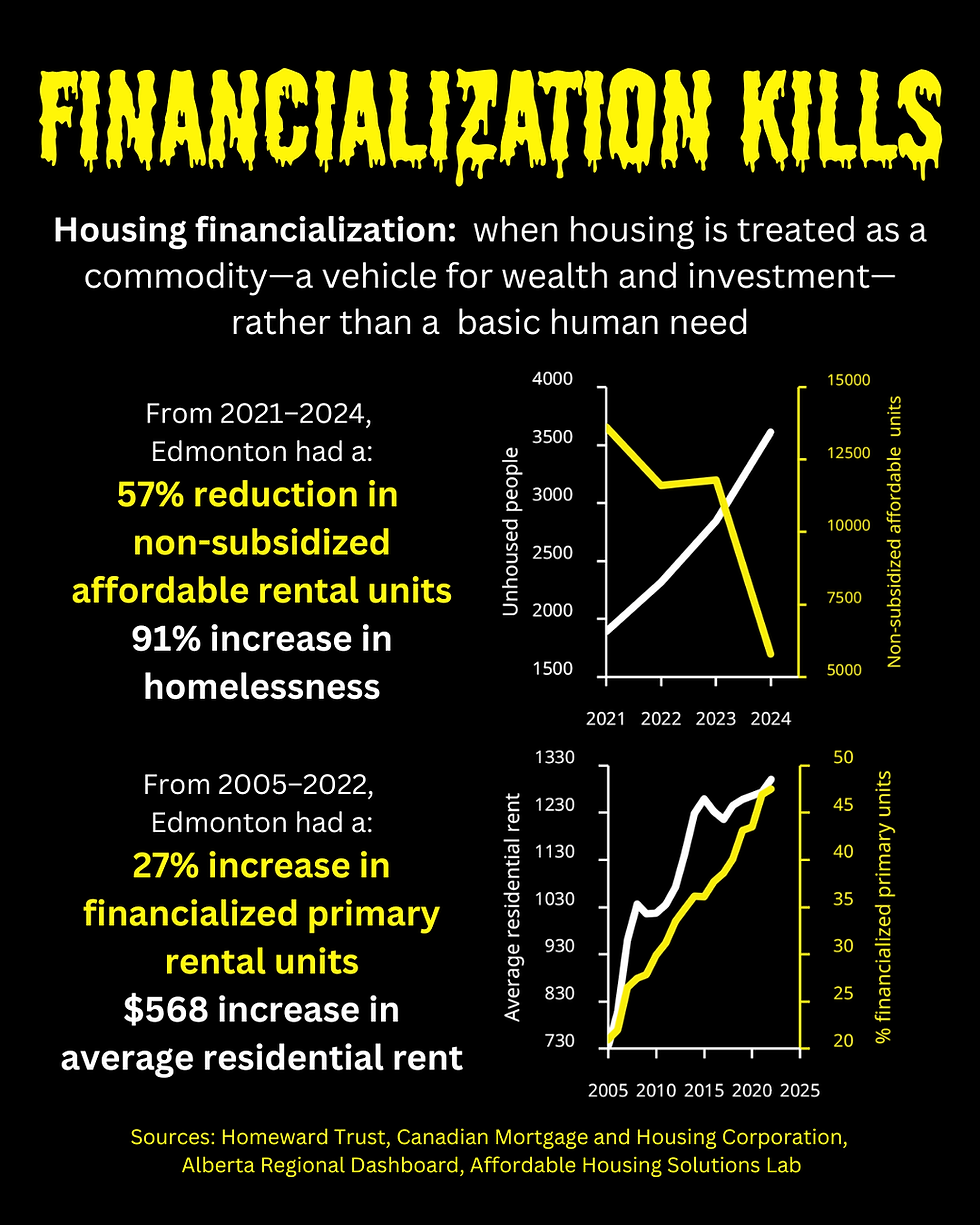
People without permanent housing are among the most vulnerable people in our city. The fundamental reason why thousands of individuals lack permanent housing in our city is the mismatch between incomes and the cost of rental housing. Poverty and rents are key determinants of the size of the homelessness (Kneebone and Wilkins 2021). Many wait weeks if not months for access to subsidized housing. People on waitlists and people who are chronically houseless are disproportionately criminalized and banished from the few public spaces where they can seek shelter and warmth. These measures are counterproductive, putting vulnerable people at greater risk of frostbite, drug poisoning and death. We need all three levels of government to step up and protect the human rights of people experiencing homelessness.
Why We're Calling Out
In calling out this enforcement response, ECOHH is not calling for the normalization of disorder as some might suggest; rather, we are amplifying the voices of people harmed and dehumanized by these practices, spotlighting the disproportionality of this response, which ECOHH believes is wrong, and calling for actions that will actually address the root cause of homelessness in Edmonton. Namely, we call on the Government of Alberta to put an end to housing waitlists by channeling its $2.1 billion surplus into housing programs that guarantee immediate access to safe, accessible and affordable housing when and where it is needed.
Furthermore, we call on the City of Edmonton to end its counterproductive and discriminatory enforcement practices that disproportionately harm people experiencing homelessness, and instead adopt compassionate, evidence-based solutions like sanctioned encampments with wraparound supports and mobilizing trained healthcare and social workers instead of enforcement officers when intervening with people experiencing homelessness.


Comments